In 1793 the abbey church above Mont Saint-Michel was emptied of its altars and taken by the new Republic as a prison, and the granite doorway they locked that year is still the entrance visitors pass through. That doorway is the object this page comes back to, because everything around it was rebuilt at least twice.
What follows is six time slices, each anchored to something you can still stand in front of: a crypt, a nave, a rampart, a prison wing, a restored roof, and the causeway you arrive on. I use this order with student groups because it turns a crowded island into a sequence instead of a pile of dates.
708: A Bishop, a Rock and a Chapel
The earliest accounts place the start in 708, when Aubert, bishop of Avranches, was told in a dream to build a chapel on the granite outcrop above the Couesnon river. He cut the first chapel into the rock itself, which is why the oldest room on the mount sits below the church rather than inside it.
The piece you can put a hand on is the crypt under the choir: a low Romanesque chamber with heavy piers, built to carry a church that kept growing upward. It takes two minutes to walk through, which is why I put it first on any visit, before the group has spent its attention on the view.
For the next two centuries the mount stayed a modest stop with a handful of monks, and the tide did most of the defensive work. Nothing about the skyline yet suggests the building that would arrive.
966 to 1228: Building Straight Up
In 966 the dukes of Normandy handed the mount to Benedictine monks, and the building campaign that follows is the reason the island reads as stacked rather than spread out. Romanesque work gave the church its nave and the deep galleries of the choir.
The turn visitors notice came between 1204 and 1228, when the Romanesque choir was replaced and the new work climbed instead of widened. The best known result is the section called La Merveille, three storeys of refectory, cloister and halls hung against the north cliff.
Reading it with a group is simple from the outside: count the levels up the cliff and you are counting the abbey's budget as well as its ambition. The sea provided stone, timber and labour, and the monks spent all three on height because there was no width left to spend on.
1337 to 1453: The Fortress Years
The Hundred Years' War reached the bay in 1337, and the mount became a working fortress with gun ports, curtain walls and a barbican. English forces took most of Normandy during the following decades and never took this.
The longest siege ran from 1423 to 1428, and the defenders held on with supplies brought by sea while the mainland changed hands around them. The walls you walk along on the ramparts largely date from this period, which is a useful reminder that the postcard view was originally a firing position.
Military value faded after the war ended in 1453, but reputation does not fade on the same schedule. A fortress nobody had captured was exactly the kind of place a central government later found convenient.
1793 to 1811: The Prison Door
The abbey church was taken over as a prison in 1793, and by 1811 Napoleon had made the mount an official state prison holding clergy and political detainees. The doorway from the first paragraph belongs to this chapter, and so does the coarse graffiti cut into the lower rooms by people with time on their hands.
The prison closed in 1863. Eleven years later, in 1874, the state listed the whole complex as a historical monument, which is the first point at which saving the building became an official concern rather than a monk's problem.
One number I give groups: by the mid nineteenth century several hundred prisoners were held here at once, in rooms that had housed monks five centuries earlier. The distance between those two uses is shorter than the tour route suggests.
1874 to 1979: Restoration and the Tide
Restoration work under Eugene Viollet-le-Duc from the 1870s gave the abbey the slate spires and vertical lines most people picture today. Part of that profile is invention rather than survival, and I say so out loud, because the standard tour usually does not.
The second half of the story is water. A dam on the Couesnon in 1969 helped silt build up, the channel shifted, and for parts of the following two decades the mount was easier to reach on foot than a tidal island should be. Since 2014 engineers have been dismantling that dam and returning the sea's share of the bay.
The bay was listed with the mount by UNESCO in 1979, which is the date most French schools use as the line between an old monument and a managed site. The remaining traces worth pointing at are:
- The crypt under the choir, seventh century in origin, Romanesque in its present piers.
- The cloister of La Merveille, built on two levels above the north cliff.
- The ramparts and gun ports added during the Hundred Years' War.
- The prison graffiti cut into the lower rooms during the state prison years.
- The granite doorway of 1793, still the route into the church.
What You See From the Causeway Today
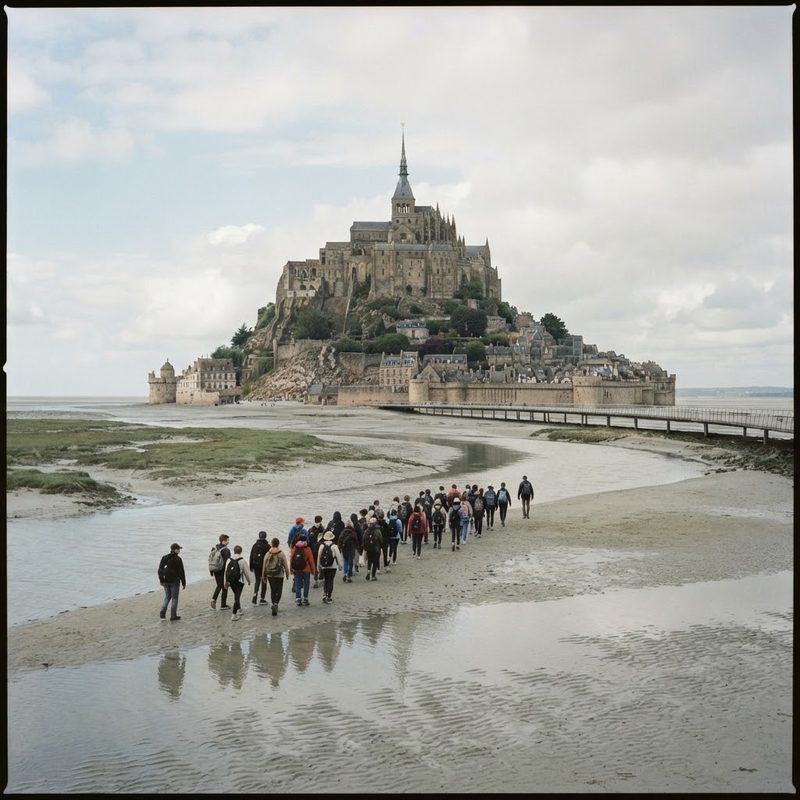
Arrive at low tide and the sequence runs in reverse: causeway, ramparts, prison level, then the church with the crypt below it. The climb from the car park to the church is a series of flights rather than one staircase, so the group naturally strings itself out, and the count that matters is a headcount at the top rather than a pace.
I brought thirty four students in March with a 07:40 coach arrival and a 16:00 departure. Four hours in the middle looked generous on paper and turned out about right: crypt first while the rooms were empty, ramparts second, village and meeting point at the fountain after that, and the only argument of the day was about lunch.
The doorway in the first paragraph is still where the prison left it, the plain way into the church that everybody uses and almost nobody notices. Six eras of building sit behind it, which makes it the honest end of the sequence: the object from 1793 is the last thing you touch on the way out.